The Great Ice Age: Do We Still Need to Attack Our Freezers with a Hairdryer?
Right then, pop the kettle on and pull up a chair. We need to have a serious chat about that ritual many of us grew up with. You know the one—it usually happened on a rainy Sunday afternoon when there was nothing decent on the telly.
I’m talking about The Defrost.
I can vividly remember my mum standing in the kitchen, surrounded by a moat of sodden towels, wielding a hairdryer like a weapon of war against a glacier that had seemingly taken up residence in the bottom drawer of our freezer. It was a proper ordeal. There were bowls of boiling water balancing precariously on shelves, plastic scrapers snapping under pressure, and the looming threat of the "puddle of shame" ruining the lino.
But here we are in the 2020s. We’ve got phones that unlock with our faces and cars that park themselves. Surely, we don't still need to spend our weekends hacking away at ice like an Arctic explorer, do we?
Well, the answer is a resounding "No"... with a rather cheeky, distinctly British "but..." attached to it. Let’s dive in, shall we?
The Myth: The Yearly Battle Against the Ice
So, why do we believe we need to defrost? For decades, this wasn’t a myth—it was a necessity written into the laws of physics. If you didn’t do it, your freezer drawer would eventually fuse shut, trapping that bag of frozen peas until the end of time.
The belief persists because old habits die hard. We saw our parents doing it, so we assume it’s just part of owning a freezer. Many of us still look at a perfectly functioning modern appliance with suspicion, waiting for the ice to creep in. We think that if we don't chip away at the frost, the freezer will explode, or at the very least, send our electricity bill into orbit.
And to be fair, for a long time, that fear was entirely justified.
A Bit of History: Why Freezers Used to Be Snow Machines
Let’s wind the clock back a bit. Before the late 90s, almost every freezer in the UK used something called Static Cooling. It sounds fancy, but it’s actually incredibly basic.
In these older units (and let’s be honest, plenty of budget ones today), the cooling coils—the bits that actually get cold—were embedded right inside the shelf plates or the lining of the box. It was a simple system, but it had a fatal flaw: humidity.
Here’s the science bit (stick with me, it’s brief!): Every time you opened the freezer door to grab a fish finger, warm, moist air from your kitchen rushed in. As soon as that moisture hit the sub-zero walls or coils, it froze instantly. It’s a process called sublimation.
Layer upon layer of this frost would build up. Now, here is the kicker—ice is actually a brilliant insulator. Think of an igloo; it keeps the cold out and the heat in. In a freezer, a thick layer of ice acts like a woolly jumper wrapped around the cooling elements.
Research shows that just 5mm of ice could force your compressor to work much harder, consuming roughly 20-30% more energy just to penetrate that icy blanket and keep your food cold. So, the "myth" was true: if you didn't defrost, you burned out the motor and paid a fortune to the electricity board.
The Truth: Enter the "Frost-Free" Revolution
Thankfully, technology moved on. Around the turn of the millennium, manufacturers started rolling out "Frost-Free" (or No Frost) technology as a standard for mid-to-high-end models. This changed the game entirely.
Unlike the old static boxes, a Frost-Free freezer works on a system called Dynamic Cooling. It’s clever stuff. Here is how it keeps your drawers ice-free without you lifting a finger:
1. The Fan Club
Instead of stagnant cold air, a fan constantly blows cool air around the cavity. This stops moisture from settling on your food or the walls. If the air is moving, the water vapour doesn't have time to park itself and turn into ice.
2. The Hidden Magic
The cooling coils aren't exposed anymore. They are hidden away behind a panel, usually at the back.
3. The Secret Cycle
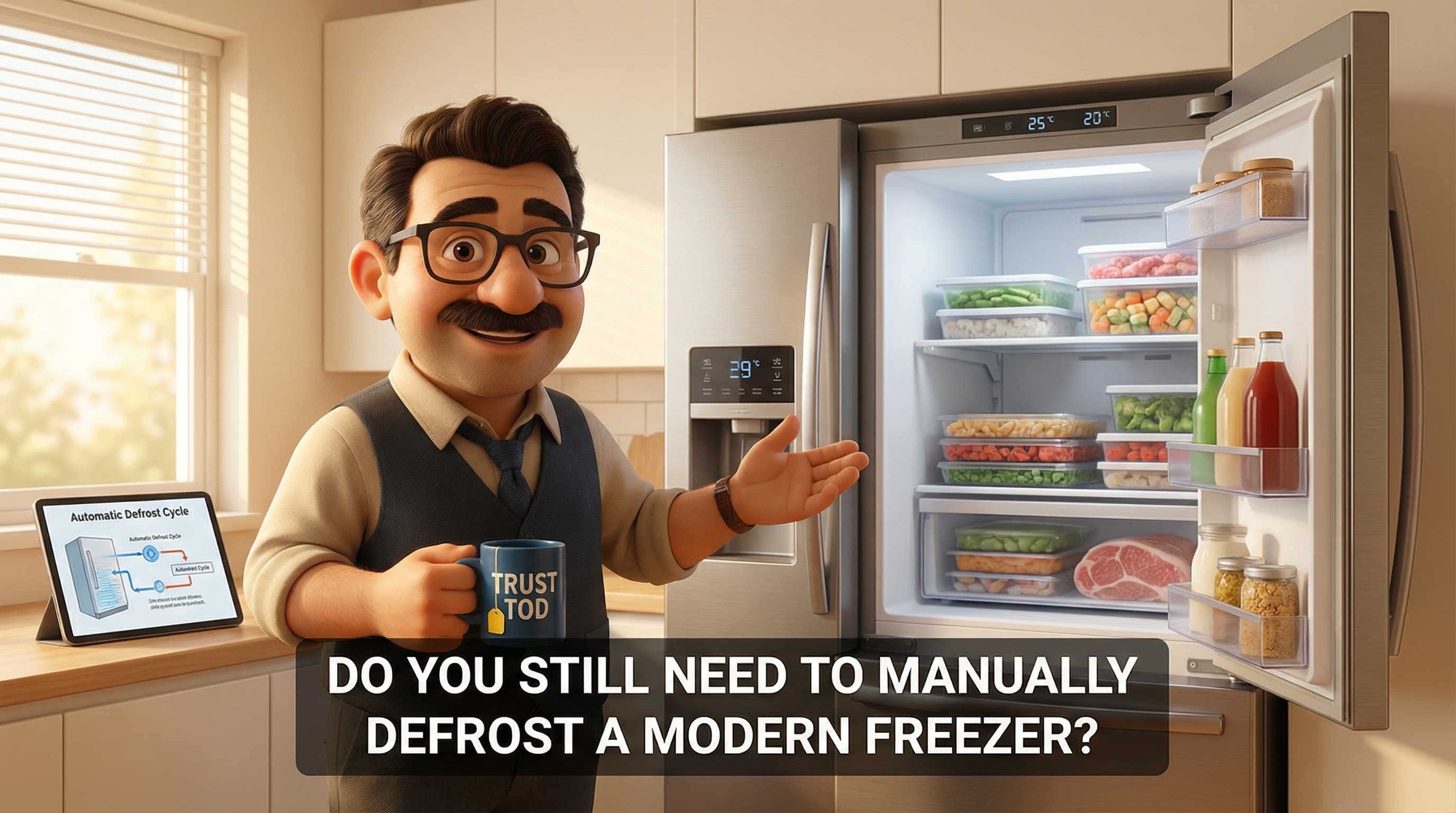
This is the bit that properly blows people's minds. A modern frost-free freezer actually has a heater inside it. Yes, a heater in a freezer!
Every so often, a timer or sensor tells the compressor to take a break and switches on a small heating element wrapped around those hidden coils. It melts any tiny bit of frost that has accumulated. The water then runs down a hidden drain channel to a tray sitting right on top of the compressor motor at the back of the fridge. The heat from the working motor evaporates the water into the room air.
It’s a beautiful, invisible cycle. You never see the ice, and you never see the water. It just works.
The "But..." (Why You Might Still Be Chipping Ice)
Now, remember I said there was a "but"? Here is where it gets a bit tricky for us UK consumers.
Unlike our American cousins who have massive kitchens and giant double-door fridges, we Brits often have to squeeze our appliances into tight spots. We love an "under-counter" freezer or a sleek "integrated" unit hidden behind a cupboard door.
Because of this, the "Frost-Free" dream isn't universal.
1. The Static Survivors
If you have a budget under-counter freezer (the type you might pick up for £150) or a standard integrated unit, there is a very high chance it uses Static Cooling.
Why? Because Frost-Free tech requires fans and ducts, which eat into the internal storage space (measured in litres). In a tiny British kitchen, manufacturers figure you'd rather have space for an extra loaf of bread than a fan.
The Reality: If you have one of these, you do still need to manually defrost it. Sorry. Get the towels ready.
2. The "Low Frost" Hybrid
You might see this term on brands like Bosch, AE, or Hotpoint. "Low Frost" isn't "No Frost." It’s a halfway house. The cooling elements are usually in the walls but designed to reduce ice buildup by about 50%.
The Reality: You still need to defrost, but perhaps only once every 18 months rather than every 6 months. It’s less hassle, but not zero hassle.
3. Total No Frost
If your appliance is a tall freestanding unit, an American-style fridge-freezer, or a high-end model from the likes of Samsung or LG, it is likely "Total No Frost."
The Reality: You never need to defrost this. If you see ice building up in a Total No Frost machine, it’s not because you’ve been negligent—it means the machine is broken. Usually, it’s a faulty door seal letting in too much air, or a broken heater sensor. Put the hairdryer away and call an engineer.
Common Misconceptions (Let's Clear the Air)
Before we wrap up, I want to tackle a few tall tales I hear down at the pub—or in my inbox at tod.ai.
"Frost-free freezers give you freezer burn."
There is a grain of truth here. Because frost-free units circulate dry air, they can dehydrate food faster than the old stagnant ones. However, freezer burn is rarely the freezer's fault—it’s yours! (Sorry, harsh but true). If you seal your food properly in airtight bags or tubs, the air circulation won't matter a jot.
"My fridge says Auto-Defrost, so the freezer must be fine."
Ah, the classic trap. In the appliance world, "Auto-Defrost" usually refers to the fridge compartment (where water runs down the back wall). "Frost-Free" refers to the freezer. Many people buy a "Combi" unit thinking it does it all, only to find the fridge looks after itself while the freezer turns into an igloo. Check the specs carefully!
"It's fine to chip the ice off with a knife if I'm careful."
Please, for the love of technology, stop doing this. Modern freezers often have cooling pipes containing isobutane gas (R600a) running immediately behind the thin plastic walls. One slip with a screwdriver or a butter knife and PSSSHHH—you’ve punctured the system. That’s game over. The fridge is dead, and you can't fix it. If you must defrost, use patience and a bowl of hot water. Never sharp objects.
The Verdict: What Should You Do?
So, do you need to defrost?
If you are buying new: I highly recommend spending the extra few quid for a "Total No Frost" model if you have the space. The energy savings over the life of the machine, combined with the sheer joy of never having to mop up defrost water again, makes it a no-brainer. Look specifically for that wording on the label.
If you have an existing freezer: Go and have a look at the back wall of the freezer compartment. Is there snow?
- No snow: You’re golden. Go make a cup of tea.
- Snow: You likely have a static or low-frost model. You need to defrost it once the ice hits about 5mm thick. It will save you money on your electric bill and stop your motor from burning out.
And remember, even if you have a fancy frost-free model, it’s still good practice to switch it off once a year and give it a wipe down with some bicarbonate of soda. Not for the ice, but just because... well, nobody likes a crumb-filled freezer, do they?
Need help finding a freezer that won't turn your kitchen into a swimming pool? I can help with that.
Find your perfect frost-free freezer at tod.ai
Related reading: