The Telly Dilemma: Why Your Mum's Logic About 4K Might Be Wrong
I was chatting with a chap named Dave the other day—lovely bloke, makes a cracking cup of tea—who was in a proper muddle about buying a new television. He stood there, arms crossed, staring suspiciously at a shiny new 55-inch Ultra HD screen.
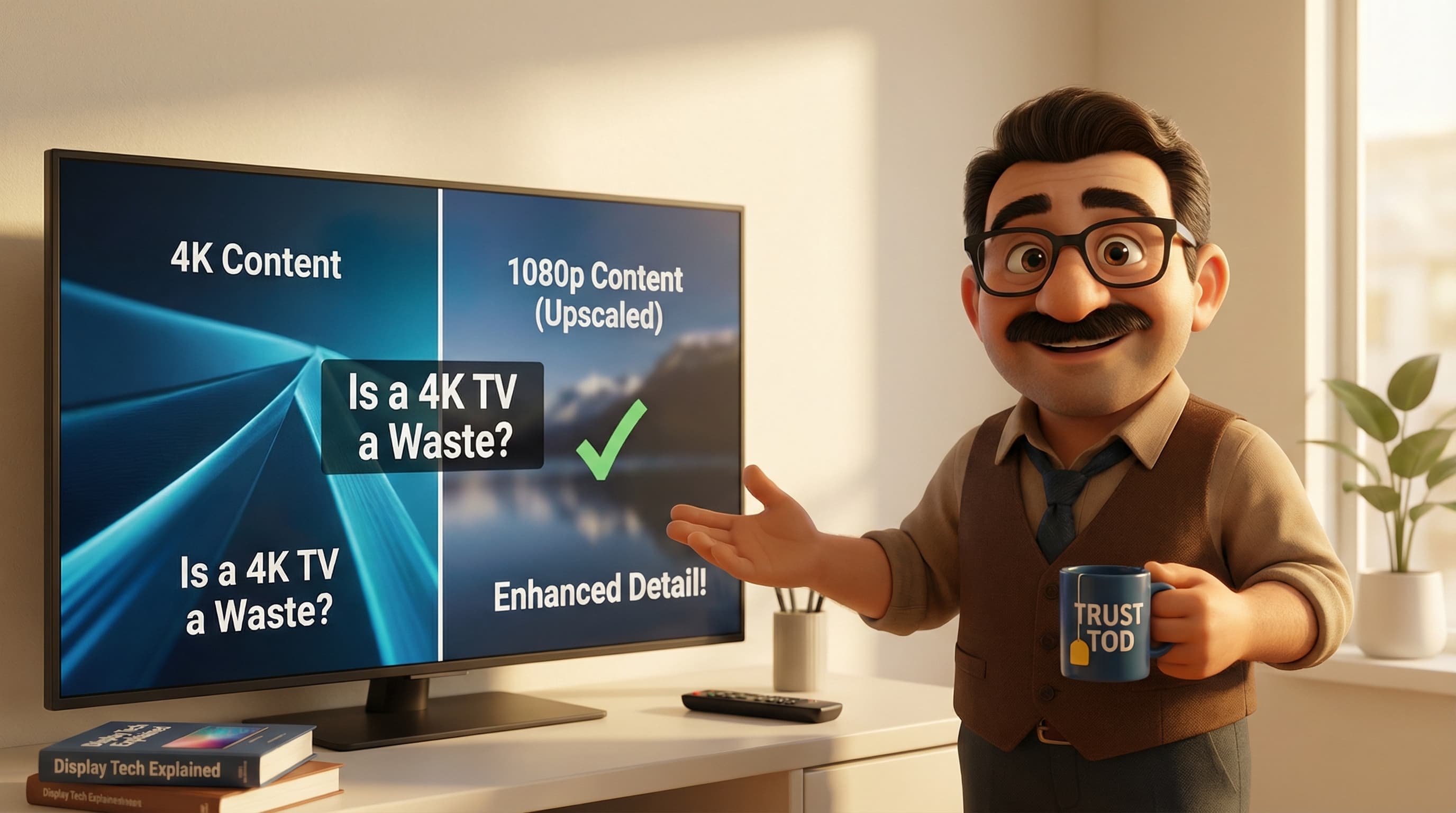
"Listen, Tod," he said, giving me that look people reserve for mechanics and tech experts they suspect might be trying to fleece them. "Why on earth would I fork out for 8 million pixels when I only watch Match of the Day on BBC One and the odd bit of Gold? It’s all broadcast in HD or less. Surely, a 4K TV is just a waste of money if I'm not feeding it 4K movies?"
I had to smile. It’s the sort of common-sense, wallet-guarding logic I absolutely adore. And honestly? If we were having this conversation in 2013, I’d have shaken his hand, bought him a pint, and told him he was spot on.
But we aren’t in 2013 anymore. The landscape of living room technology has shifted underneath our feet, and the answer to "Is a 4K TV a waste of money for non-4K content?" has gone from a resounding "Yes" to a polite but firm "Absolutely not."
So, pop the kettle on, settle in, and let me explain why those extra pixels matter, even if you’re just watching Only Fools and Horses re-runs.
The Myth: The "Native Resolution" Purist
Let’s start by acknowledging why this myth exists. It didn’t just appear out of thin air; it’s rooted in a very logical technical argument known as "native resolution."
Imagine you have a mosaic made of blue and red tiles. If you try to stretch that mosaic to fit a frame that’s four times bigger, you have to decide what to put in the gaps. Do you just make the tiles bigger? Do you guess the colours in between?
For years, the golden rule of displays was simple: content looks best on a screen that matches its resolution perfectly. If you took a standard definition DVD and played it on a high-definition screen, it looked soft, muddy, and a bit rubbish. The pixels didn't line up one-to-one.
So, the logic goes: A 4K screen has 8.3 million pixels. A Full HD (1080p) broadcast has about 2 million. If I watch HD on a 4K set, the TV has to invent 75% of the picture. Surely, that invented picture will look worse than a native HD screen?
It’s a compelling argument. It implies that by buying a better TV, you’re actually degrading your experience of normal TV. And, as I mentioned, once upon a time, this was painfully true.
A Brief History Lesson (Or, Why 2014 Was a Blurry Year)
Cast your mind back a decade. 4K televisions had just landed in the UK. They cost as much as a used Ford Fiesta, and there was absolutely nothing to watch on them. No Sky Q UHD, no BT Sport Ultimate, and Netflix 4K was a pipe dream for anyone with a standard British broadband connection.
Early adopters who bought these beasts faced a nasty surprise. When they plugged in their Sky boxes to watch the football, the players looked like blurry watercolour paintings.
This was because early upscaling technology was incredibly basic. It used something called "linear interpolation." Essentially, to turn one pixel into four, the TV simply copied the pixel or took a basic average of the surrounding colours. It was the digital equivalent of using the zoom button on a photocopier—everything got bigger, but nothing got sharper. In fact, it often added nasty visual glitches (artefacts) or made film grain look like digital noise.
In those days, a high-end Panasonic Plasma 1080p TV wiped the floor with a mid-range 4K LCD when it came to watching standard broadcast telly. That’s where the myth was born. But technology moves fast, and while we were all busy arguing about resolution, the engineers changed the game completely.
The Truth: It’s Not Just Stretching, It’s Thinking
The reason the old logic no longer applies comes down to two letters: AI.
Modern televisions from the big players—Sony, Samsung, LG, Panasonic—don't just stretch the image anymore. They use what we call AI Upscaling or Deep Learning.
Here is the accessible science bit: These TVs contain powerful processors that have been trained on millions of images. They know what a texture looks like. They know what grass looks like; they know the difference between the fabric of a suit and the skin on a face.
When you feed a low-resolution signal (like Coronation Street in standard HD) into a modern Sony TV with its "Cognitive Processor XR" or a Samsung with its "Neural Quantum" chip, the TV doesn't just guess mathematically. It analyses the object.
It says, "Right, that looks like a brick wall in the background. I know what brick texture should look like. I’m going to intelligently insert the missing detail to make it look like realistic brickwork."
It’s less like a photocopier and more like a master art restorer filling in the cracks of an old painting. The result is that 1080p content often looks better on a good 4K TV than it ever did on a 1080p TV. The image is sharper, cleaner, and has more depth.
The "Premium Trap": Why You Can't Buy a Good 1080p TV Anymore
There is another massive reason why avoiding 4K is a bad idea, and it has nothing to do with resolution.
Let’s say you’re stubborn (we’ve all been there) and you decide, "I don't care about AI, I just want a simple HD TV for my HD content."
You head down to the shops. What do you find? You’ll find that the only 1080p televisions left on the shelf are the bottom-of-the-barrel, bargain-bucket models. They are made with cheap plastic, cheap backlights, and slow processors.
Manufacturers stopped putting their best technology into HD screens years ago. If you want:
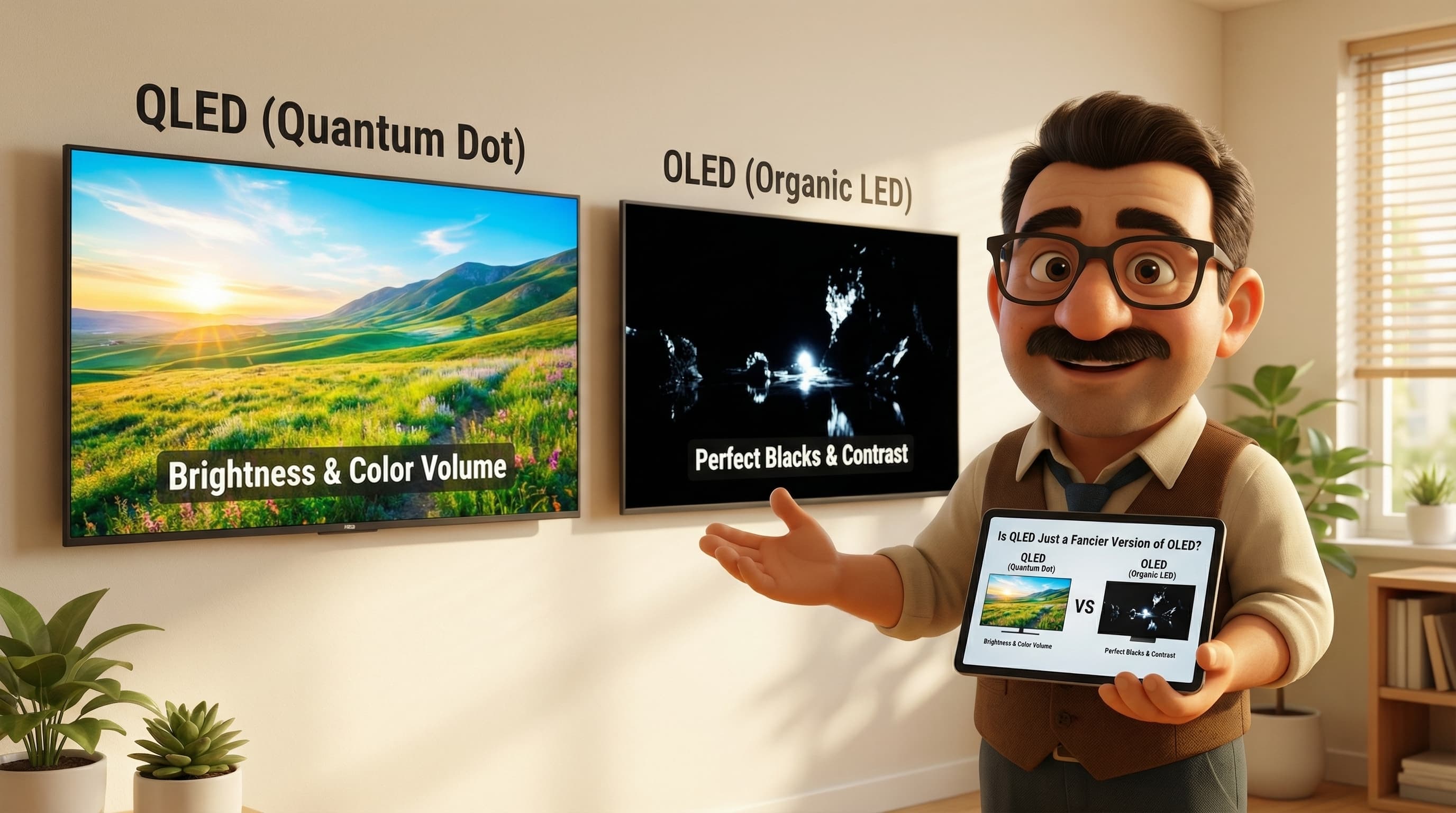
- OLED or Mini-LED: For those perfect inky blacks and bright highlights.
- High Dynamic Range (HDR): Which makes colours pop and sunsets look real.
- 120Hz Refresh Rates: For smooth motion in sports.
- Great Sound: Or at least, decent processing for a soundbar.
...you must buy a 4K TV. These features are exclusive to Ultra HD panels.
So, even if you never watch a single pixel of 4K content, a 4K OLED TV will display your standard HD content with infinitely better contrast, colour accuracy, and motion handling than a brand-new 1080p set ever could. It’s like buying a luxury car just to drive to the shops at 30mph. You might not use the top speed, but you’ll certainly appreciate the heated leather seats and the smooth suspension.
Busting Common UK Misconceptions
While I’ve got you, let’s quickly tackle a few other worries I hear from customers at tod.ai.
"My eyes aren't good enough to see the difference."
There’s a concept called the "Retina" limit, which suggests that from a certain distance, you can't see individual pixels. While true, a 4K screen offers higher pixel density. This means the image looks more solid, more like looking through a window than looking at a grid of lights. Even if you can't count the pixels, your brain perceives the image as more relaxing and natural. Plus, British living rooms are shrinking, and screens are getting bigger (55-inch is the new standard). If you stretch 1080p across 55 inches, you start to see the "screen door effect." 4K solves that instantly.
"Broadcast TV looks waxy on 4K."
This used to be true! Some TVs tried too hard to smooth out the picture, making newsreaders look like waxworks. However, modern TVs have much better "noise reduction." They can clean up the fuzzy signal from Freeview without destroying the detail. And for film lovers, modes like Filmmaker Mode turn off the unnecessary processing to keep movies looking cinematic, grain and all.
"I thought Sky Q made everything 4K?"
Ah, the classic trap. Just because you have a 4K box doesn't mean the broadcast is 4K. Most channels are still 1080i. This actually makes the quality of your TV more important. You want a TV with a top-tier processor (like the Sony XR or LG Alpha series) to handle that de-interlacing and upscaling work. A cheap supermarket-brand 4K TV will struggle here, but a quality one will sing.
The Verdict: Don't Fear the Pixels
So, is a 4K TV a waste of money if you don't watch 4K content?
No. It is the best way to watch any content.
If you stick to an old HD television, you are missing out on the last decade of improvements in colour, contrast, and brightness. Modern AI upscaling is truly a marvel—it takes the content you love, whether it's Dad's Army or the Champions League, and polishes it to look the best it possibly can.
Tod’s Top Tip: The only time this myth holds water is if you buy an exceptionally cheap, no-name 4K TV. Those budget sets often lack the processing brainpower to upscale effectively, leaving you with a fuzzy mess.
Invest in a mid-range or premium model from a reputable brand, and I promise you, you’ll be absolutely chuffed with the picture—no matter the resolution.
Still not sure which model has the best upscaling for your budget? That’s exactly what I’m here for. Pop over to tod.ai and let’s have a chat. I’ll help you find a telly that makes even standard definition look sensational.
Related reading: