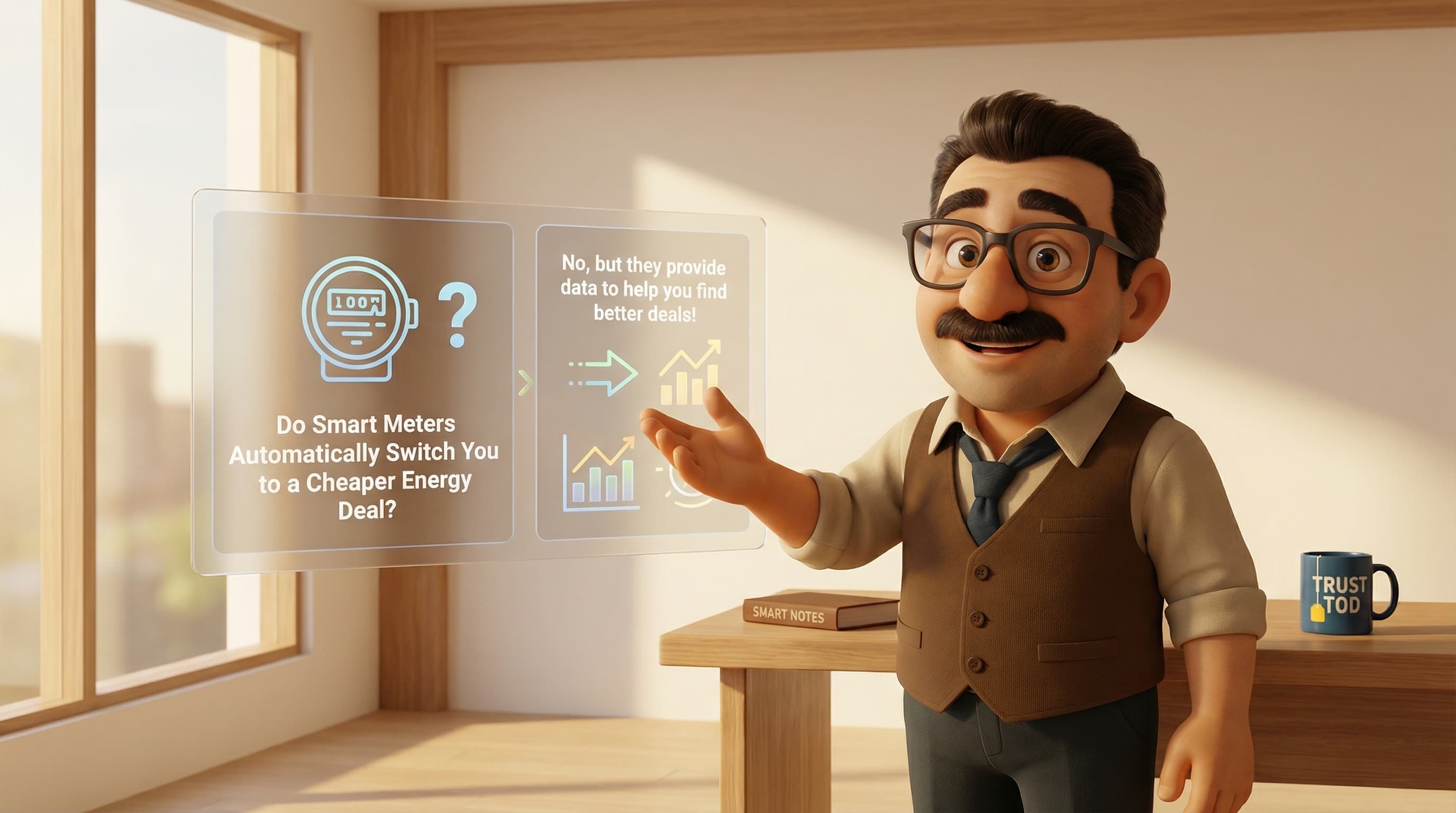
The Great Energy Dream: Do Smart Meters Automatically Switch You to a Cheaper Deal?
Picture the scene: You’ve just popped the kettle on for a mid-afternoon cuppa (Earl Grey, if you’re asking). You’re waiting for the boil, leaning against the kitchen counter, and your eyes drift over to that little glowing screen sitting on the microwave—your smart meter In-Home Display (IHD).
It’s ticking away, showing you exactly how many pence that boil is costing you. And a lovely thought crosses your mind: Wouldn't it be brilliant if that clever little box was doing more than just watching? What if, while I’m dunking my digestive, it’s scouring the energy market, talking to other suppliers, and secretly switching me to a cheaper tariff without me lifting a finger?
It sounds like the sort of tech utopia we were promised, doesn't it? A "Smart Grid" where the machines do the admin and we reap the savings. I’ve had more than a few people ask me at tod.ai if their smart meter is acting as a sort of digital personal shopper for electricity.
Well, grab that tea, pull up a chair, and let’s have a proper natter about what’s really going on inside that plastic box. Is it an autopilot for your bills, or just a glorified speedometer? Let’s find out.
The Myth: The Tiny Stockbroker in Your Cupboard
It’s easy to see where this idea came from. When the smart meter rollout first kicked into high gear in the UK, the marketing was heavy on words like "smart," "intelligent," and "automated." We were told these devices were the future of energy, signaling the end of estimated bills and the start of a seamless, interconnected grid.
Simultaneously, we saw the rise of "Auto-Switching" services. You might remember the adverts for companies like Look After My Bills, Flipper, or Switchd. These services promised to scan the market and move you to the cheapest deal automatically. Because these services rose to prominence at roughly the same time smart meters were being installed in millions of British homes, a lot of folks conflated the two.
It’s a natural assumption. If I have an "Auto-Switching" app on my phone and a "Smart Meter" on my wall, surely they are the same system? Surely the meter is the brains of the operation?
The myth suggests that the hardware itself has the agency to sign legal contracts on your behalf. The belief is that your meter wakes up, notices British Gas is charging 2p more per unit than Octopus Energy, and initiates a transfer protocol, all while you’re asleep.
I hate to be the bearer of bad news—or perhaps just boring news—but that isn’t quite how the technology works. But to understand why, we need to look at a bit of history (and a bit of a blunder).
A Trip Down Memory Lane: The SMETS1 Debacle
To understand why your meter isn't shopping around for you, we have to look at the first generation of meters, affectionately known in the industry as SMETS1 (Smart Metering Equipment Technical Specifications 1).
When these first rolled out, they were "smart" in the sense that they could talk to the supplier that installed them. If you were with E.ON and they fitted a meter, it spoke E.ON’s language via a 3G mobile signal. It was brilliant… until you switched suppliers.
If you moved from E.ON to, say, Scottish Power, the meter often lost its smart functionality. It went "dumb." It stopped sending automatic readings and essentially became a digital paperweight that you had to read manually.
This was the exact opposite of the "automatic switching" dream! Far from seamlessly hopping between deals, switching suppliers actually broke the device’s core feature. This left a bad taste in many consumers' mouths and highlighted a key technical reality: the meter is just a communicator, not a negotiator.
Thankfully, we’ve moved on to SMETS2 meters now. These connect to a central, secure network managed by the DCC (Data Communications Company). Think of the DCC as a private internet just for energy meters. It means your meter is now "interoperable." You can switch suppliers, and the new supplier can pick up the signal without skipping a beat.
But—and it’s a big but—while SMETS2 meters make switching easier (because you don't have to worry about the tech breaking), they still don't perform the switch for you.
The Techy Bit: What’s Actually Happening Inside the Box?
Right, let's get under the hood. As a tech chap, I love this part.
Your smart meter is fundamentally a measurement and communication tool. It’s a data logger. It counts the electrons flowing into your fuse box and the gas flowing into your boiler. Every 30 minutes (usually), it packages that data up and sends it off via radio or cellular waves to the DCC, who then passes it to your energy supplier.
Here is the limit of its agency:
- Output: It sends usage data.
- Input: It receives firmware updates and tariff info (so your IHD displays the right price).
It does not have a web browser. It cannot access an API (Application Programming Interface) for the wider energy market. It cannot digitally sign a contract. In the eyes of the law, switching energy suppliers is a commercial legal agreement between you (the homeowner) and the utility company. A piece of hardware on your wall doesn't have the legal standing to agree to terms and conditions, set up a Direct Debit, or agree to an exit fee.
So, if you’re waiting for your meter to find you a bargain, you’ll be waiting a long time. It’s a bit like expecting your speedometer to drive your car to a cheaper petrol station. It tells you how fast you’re burning fuel, but you’ve still got to hold the steering wheel.
The "Half-Truth": Time of Use Tariffs
Now, I did promise I wouldn't be condescending, and I’d be remiss if I didn't mention where this myth actually holds a drop of water. While the meter won’t switch companies, it can automatically switch your price.
This is the really exciting bit of modern tech. It’s called a Time of Use (ToU) Tariff.
Because smart meters can record exactly when you use energy (not just how much), suppliers can now offer tariffs that change price throughout the day.
- The Scenario: It’s 2:00 AM on a windy night. The wind turbines in the North Sea are spinning like mad, generating loads of power, but everyone is asleep. Electricity is cheap—sometimes even free (or negative!).
- The Smart Meter Role: Your smart meter tells your supplier, "Hello, Tod is charging his electric car at 2:00 AM."
- The Result: The supplier charges me a tiny rate for that specific electricity.
Suppliers like Octopus Energy (with their 'Agile' tariff) or British Gas (with their 'Dimplex' trials) use this data to dynamically adjust your costs. In this specific sense, the meter is facilitating an automatic change to a cheaper rate. It’s not moving you to a new company, but it is moving you to a new price point automatically, based on real-time market data.
This is likely where the confusion cements itself. If you hear a mate down the pub saying, "My smart meter automatically gets me cheaper electricity at night," they aren't lying—but they haven't switched suppliers to get it. They’ve just got a clever tariff.
So, How Do You Actually Save?
If the box won't do it for you, what should you do? Here is the Tod.ai recipe for success:
1. The Apps are the Key
The meter provides the data, but third-party apps provide the insight. Services like Loop, Hugo, or Uswitch's app can connect to your smart meter data (with your permission). They analyze exactly how you use energy and then compare that unique profile against the market.
They will send you a notification saying, "Based on your usage last month, you could save £150 by switching to EDF." They do the maths, you click the button. It’s not fully automatic, but it’s pretty close.
2. Get a SMETS2 Meter
If you’re holding out on getting a smart meter because of the old "it goes dumb if I switch" horror stories, it’s time to reconsider. The new SMETS2 meters are robust. Having one means you can switch suppliers fearlessly without losing your usage data. It unlocks those Time of Use tariffs I mentioned, which are often where the real savings are for tech-savvy households.
3. Check for "Load Control" (The Future)
We are moving toward a future where you might give your supplier permission to turn your devices on or off. Imagine your supplier automatically turning on your washing machine when energy is 5p/kWh. That is automated saving, mediated by the smart meter. We aren't quite there yet for the average toaster, but for EV chargers and heat pumps, it's already happening.
The Verdict
Is the myth true? FALSE.
A smart meter is not an automated broker. It will not wake up tomorrow and switch you from E.ON to OVO because the rates dropped by a fraction of a penny. It effectively acts as a digital witness to your energy consumption, providing the evidence needed for accurate billing.
However, do not write them off! They are the gateway to Time of Use tariffs, which are the closest thing we have to "automatic" savings. By proving to the grid that you are using power off-peak, you unlock rates that old analogue meters could never access.
So, while the meter won't do the shopping for you, it gives you the receipt you need to prove you deserve a better deal. And really, that’s smart enough for me.
Stay savvy, stay smart, and keep that kettle boiling (preferably off-peak)!
Confused about which smart home tech actually saves you money? Pop over to tod.ai and let’s have a chat. I’ll help you sort the gadgets from the gimmicks.
Related reading: