The Great Pan Panic: Do You Really Need to Remortgage for 'Special' Cookware?
Picture the scene. You’ve finally decided to renovate the kitchen. You’ve picked out the cabinets—probably a lovely shade of sage green or navy, very trendy—and now you’re standing in the appliance aisle of a large electrical retailer. You’ve got your eye on a sleek, glossy induction hob. It looks like something from a spaceship, wipes clean with a single swipe, and boils water faster than you can say “put the kettle on.”
But then, a salesperson looms out of the shadows. They nod gravely at the hob and whisper, “Of course, you know you’ll need special pans for this one. None of your old stuff will work. You’ll need the Titanium-Infused-Space-Age-Mega-Set. That’s another £500, please.”
Your heart sinks. Suddenly, the induction hob isn’t an energy-saving upgrade; it’s a financial black hole requiring a complete inventory overhaul. You walk away, clutching a brochure for a standard gas hob, feeling a bit defeated.
I hear this story constantly at tod.ai. It is, without a doubt, the single biggest barrier preventing Brits from switching to induction cooking. And I am here today, with a cup of tea in hand, to tell you that it is absolute poppycock.
Let’s debunk the myth of the “special” induction pan once and for all.
The Myth: The "Magic" Pan Requirement
So, why does this myth persist with such tenacity?
It largely comes down to language. For years, retailers and manufacturers have used terms like “Induction Ready,” “Specialist Induction Technology,” and “Premium Induction Series.” When we see words like that, our brains naturally assume that the technology is proprietary, complex, and crucially, expensive.
We treat induction hobs as if they are incredibly fussy eaters that will only digest the culinary equivalent of caviar. The prevailing belief is that unless a pan costs as much as a small car and has a logo that sounds like a German luxury sedan, the hob simply won’t switch on. Or worse, people fear they’ll damage the glass, or that the food won’t cook properly.
It’s a classic case of fear-based marketing mixing with a lack of technical understanding. But to understand why this myth exists, we have to hop into our time machine and go back to a time when mullets were cool and kitchens were orange.
A History Lesson: When the Myth Was Actually True
To be fair to the salespeople of the past, there was a time when this advice was spot on. If we rewind to the late 1970s and 80s, induction cooking was the new kid on the block—a futuristic luxury that cost a fortune.
Back then, the British kitchen cupboard looked very different. We were a nation in love with spun aluminium and copper. Why? Because they were cheap, light, and conducted heat brilliantly on gas flames and electric coil plates. If you opened a cupboard in 1985, you’d likely find a stack of battered aluminium saucepans and maybe a copper-bottomed frying pan.
The problem? Aluminium and copper are non-magnetic.
When early adopters installed those first induction hobs, they faced a genuine crisis. They’d place their trusty aluminium pot on the glass, and… nothing. Silence. No heat. Their entire collection was rendered useless overnight.
Furthermore, in those days, cookware manufacturing wasn’t as sophisticated as it is now. You generally bought pans specifically for gas (thin bases) or electric plates (heavy, flat bases). Manufacturers hadn’t yet figured out how to make a “universal” pan cost-effectively. So, if you wanted a non-stick frying pan that worked on induction in 1990, you really did have to hunt down a niche, expensive specialist product.
It was this trauma—the Great Pan Cull of the late 20th Century—that cemented the idea that induction requires a complete and costly kitchen reinvention.
The Truth: It’s Not Magic, It’s Magnets
Let’s strip away the marketing fluff and look at the physics. Don’t worry, I won’t get too bogged down in equations—I haven't had enough coffee for that yet.
Induction hobs don't generate heat like a radiator; they generate a magnetic field. Underneath that glass surface is a coil of copper wire. When you turn the hob on, an alternating electric current flows through that coil, creating a magnetic field that oscillates at high frequency.
When you place a pan on top, that magnetic field needs to penetrate the metal of the pan's base. If the metal is ferrous (contains iron), the magnetic field induces electrical currents—called eddy currents—inside the pan itself. The resistance of the metal to these currents creates heat.
That is the only requirement: Iron.
The pan doesn't need a microchip. It doesn't need to be blessed by a celebrity chef. It doesn't need to cost £100. It just needs to be magnetic.
The Evolution of the 'High Street' Pan
This is where the modern reality shines. In the last twenty years, manufacturing has changed dramatically. It is no longer cost-effective for big brands to run separate production lines for “gas pans” and “induction pans.”
Instead, the vast majority of cookware sold in the UK today—from the high-end stuff at John Lewis to the budget ranges in Tesco, Sainsbury’s, and IKEA—is built with a “bonded” or “encapsulated” base.
Even if the main body of the pan is aluminium (which is great because it’s light and conducts heat well), the manufacturer bonds a plate of magnetic stainless steel to the bottom. This steel plate makes the pan compatible with induction.
This means that a £15 frying pan from IKEA’s '365+' range or a generic 'Go Cook' pot from Tesco is often just as technically compatible with your induction hob as a £150 pan from a premium French brand. The barrier to entry has completely collapsed.
Busting the Common Misconceptions
Even with the science explained, I know some of you are still sceptical. Let’s tackle the most common worries I hear at tod.ai.
"But the salesman said I need the specific brand's pans!"
Ah, the old cross-selling trick. If you buy a Bosch or Neff hob, they will often try to sell you a branded set of cookware to go with it. These are perfectly nice pans, but they are absolutely not required. Your warranty is not void if you use a generic pot. It’s like a car salesman telling you that you can only drive your new Ford if you wear Ford-branded trainers. Rubbish.
"I'm worried about scratching the glass."
This is a valid concern, but the solution is brilliant. Because the hob surface itself doesn't heat up (only the pan gets hot), you can actually put a protective layer between the pan and the glass. A piece of parchment paper, a silicone baking mat, or even a sheet of newspaper will prevent scratches, and the magnetic field will shoot right through it to heat the pan. Try doing that on a gas flame!
"My old cast iron skillet won't work."
On the contrary! That rusty old Le Creuset or the heavy unbranded skillet you’ve had for twenty years is actually the best pan for induction. Cast iron is pure ferrous metal. It connects beautifully with the magnetic sensors and retains heat incredibly well. You don’t need new tech; you need the stuff your grandmother used.
"What about that buzzing noise?"
Sometimes, you might hear a faint clicking or buzzing when cooking on high power. People often panic and think their cheap pan is breaking the hob. It’s not. It’s usually caused by the vibration of the different layers of metal in the pan's base (magnetostriction). It’s perfectly safe. While heavier, more expensive pans might be slightly quieter because they dampen the vibration better, a buzzing pan works just fine.
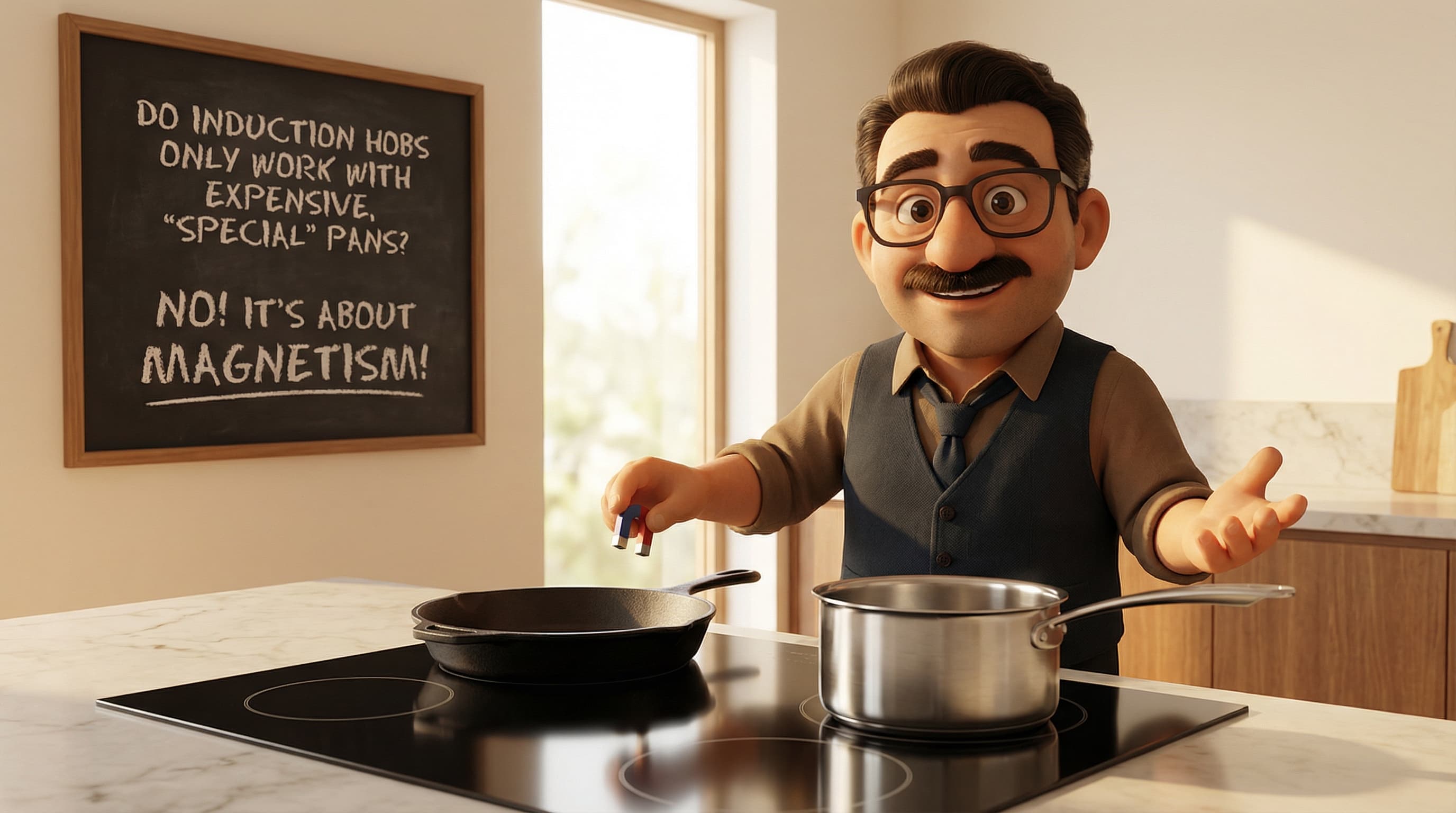
The Verdict: Take the Magnet Test
So, before you dismiss induction as too expensive, or before you throw out all your current cookware in a panic, I want you to do one simple thing.
Go to your fridge. Take off that magnet you bought on holiday in Cornwall.
Now, walk over to your pan cupboard. Turn your pots and pans upside down and stick the magnet to the base.
- If it sticks firmly: Congratulations! That pan is induction ready. You don’t need to replace it.
- If it slides off or doesn't stick: It won't work.
You will likely find that half your cupboard is already compatible, especially if you have stainless steel or cast iron cookware. And for the few items that aren't? You don't need a specialist store. Pop down to your local supermarket or Argos. Look for the little coil symbol on the packaging, or just take your magnet with you to the shop (you might get some funny looks, but you’ll save a fortune).
The Bottom Line: Don't let the "special pan" myth keep you cooking on gas. The future is electric, it's efficient, and it's compatible with that £12 frying pan you bought three years ago.
Struggling to choose the right hob for your specific kitchen setup? Or maybe you want to find the best value induction-compatible cookware set? That’s what I’m here for. Pop over to tod.ai and have a chat. I’ll help you sort the tech from the tosh, so you can get back to what matters—making a brilliant dinner.
Cheers,
Tod
Related reading: