The Great Kettle Con: Why Your Smart Plug Won’t Brew Your Morning Cuppa
Picture the scene. It’s a grey, drizzly Tuesday morning in February. The alarm goes off, and frankly, the duvet feels like the only safe place in the universe. You’re desperate for a cuppa, but the thought of shuffling across the cold kitchen tiles to flick the kettle switch is almost too much to bear.
Then, a lightbulb moment! You remember seeing an advert for those nifty little smart plugs. “Make any device smart,” the box promised. You think, “Right, I’ll plug the kettle into one of those, tell Alexa to turn it on at 7:00 AM, and wake up to boiling water. I am a genius. I am living in the future.”
I hate to be the bearer of bad news, but hold your horses. While I’d love to tell you that this £15 hack is the answer to your morning prayers, the reality is a bit of a sticky wicket. It’s one of the most persistent myths in the UK smart home world, and it’s time we had a proper chat about why it (mostly) doesn’t work—and why trying it might be a bit dangerous.
The Myth: “If It Plugs In, It Can Be Smart”
Let’s look at where this idea came from, shall we? Back around 2012, when the “Internet of Things” was just a fancy buzzword, companies like Belkin and TP-Link started flooding the market with affordable smart plugs. The marketing was brilliant. They’d show a table lamp. You plug the lamp into the smart plug, leave the lamp’s switch ‘On’, and boom—you can control the light from your phone.
We all watched that and thought, “Blimey, that’s clever. I’ll do that with the toaster, the fan, and the kettle.”
The logic seems sound. A smart plug is just a gatekeeper. It cuts the power or lets it flow. If you leave your appliance switched on, giving it power should make it go. Simple, right?
Well, it was simple. Until technology got cleverer than the plug.
A Trip Down Memory Lane: When It Actually Worked
Here is the thing: if you were trying this hack in 2005, it probably would have worked a treat.
Back in the day, our appliances were wonderfully mechanical. We’re talking about what engineers call bistable mechanical switches. Think of your nan’s old kettle or a chunky desk fan. When you clicked that rocker switch down, it stayed down. It was a physical connection. If you pulled the plug out and put it back in, the switch was still down.
It was the era of the Goblin Teasmade (a true British icon, may it rest in peace). We’ve always been obsessed with waking up to tea. So, if you had a basic plastic kettle twenty years ago, you could fill it up, click the switch down, turn the wall socket off, and wait. When the timer (or smart plug) restored power, the circuit completed, and Bob’s your uncle—boiling water.
But time marches on, and so does health and safety.
The Truth: The “Computer Says No”
Fast forward to today. Walk into Currys or John Lewis, pick up a nice kettle, and chances are it’s not just a heating element and a spring anymore. It’s a computer.
Most modern appliances utilize momentary switches (soft switches) or digital logic boards. You know the type—you press a button, it clicks gently, and a light comes on. But the button pops right back up.
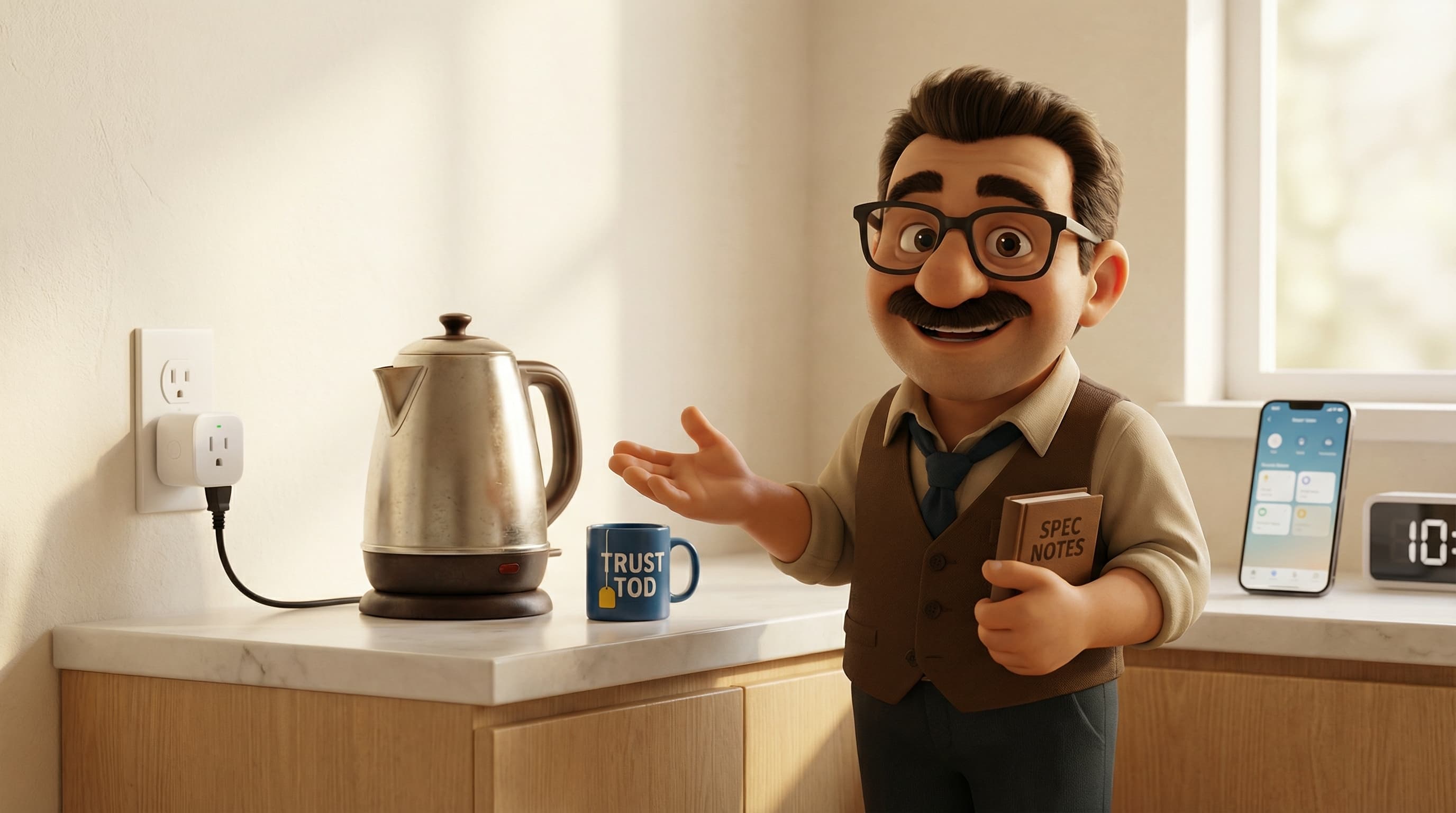
When you cut the power to a digital kettle (which is what a smart plug does when it turns off) and then restore the power, the kettle doesn’t just resume boiling. It wakes up in Standby Mode. It sits there, blinking a little LED at you, waiting for a human to press the “Start” button again. It’s a safety handshake. The kettle is basically asking, “Are you sure you want me to get hot? Is there water in me? Are you watching?”
So, your smart plug turns on at 7:00 AM, electricity flows to the kettle base, the kettle beeps to say “Hello, I have power,” and then... it does absolutely nothing. You walk into the kitchen to cold water and a confused notification on your phone.
The Exceptions
There are still a few “dumb” appliances out there. If you have a bog-standard slow cooker with a manual rotary dial (Low/High/Off), the smart plug hack works perfectly. Same for basic electric heaters with physical rockers. But for anything that beeps when you plug it in? Forget it.
The Safety Wobbly: Why You Shouldn’t Force It
Now, I know what some of you tenacious tinkerers are thinking. “I’ve seen a video on YouTube, Tod! I can just tape the switch down!”
Please, put the gaffer tape away.
Trying to bypass the mechanism of a kettle is a genuinely dangerous idea. Modern kettles have a steam tube and a bimetallic thermostat designed to trip the switch off when the water boils. If you tape that switch down to force it to work with a smart plug, you are disabling the mechanism that stops it from boiling dry.
A kettle that doesn't stop boiling will eventually boil away all the water, melt the element, melt the plastic housing, and potentially set your kitchen on fire. No cup of tea is worth burning down the house, mate.
The Voltage Issue
There is another uniquely British problem here: Power.
In the UK, our kettles are beasts. We love a fast boil, so our kettles typically draw 3000 Watts (3kW). That is a massive amount of energy.
A high-quality smart plug (like those from TP-Link or Eve) is usually rated for 13 Amps and roughly 3120W, which is just enough. However, the market is flooded with cheap, uncertified smart plugs that are only rated for 10 Amps (2300W).
If you plug a 3kW British kettle into a cheap smart plug designed for a table lamp, you are going to melt the plug. Best case scenario? It stops working. Worst case? Scorch marks on your wall socket or worse. Always check the “Max Load” before plugging anything that heats up into a smart device.
The Verdict: What Should You Do?
So, is the dream dead? Not entirely. You just need the right kit for the job.
If you want a smart kettle, don’t try to hack a dumb one. Buy a smart one. Manufacturers like Sage, Govee, and WeeKett make kettles with integrated Wi-Fi. They are designed safely with sensors to check water levels before they accept a remote command. They can hold water at specific temperatures (perfect for you green tea drinkers) and connect directly to Alexa or Google Home.
Yes, they cost a fair bit more than a tenner. But they work, they won’t melt, and they’ll have that brew ready for you without the fuss.
Tod’s Takeaway: Save your smart plugs for the table lamps, the slow cooker, and the Christmas tree lights. When it comes to the kettle, either invest in a proper smart appliance or embrace the morning ritual of shuffling to the kitchen. It’s good cardio, isn’t it?
Need help finding a smart kettle that won't break the bank? Or maybe you want to know which smart plugs are safe for your heaters? Head over to tod.ai and let's have a chat. I’ll sort you out with the best kit for your home.
Related reading: