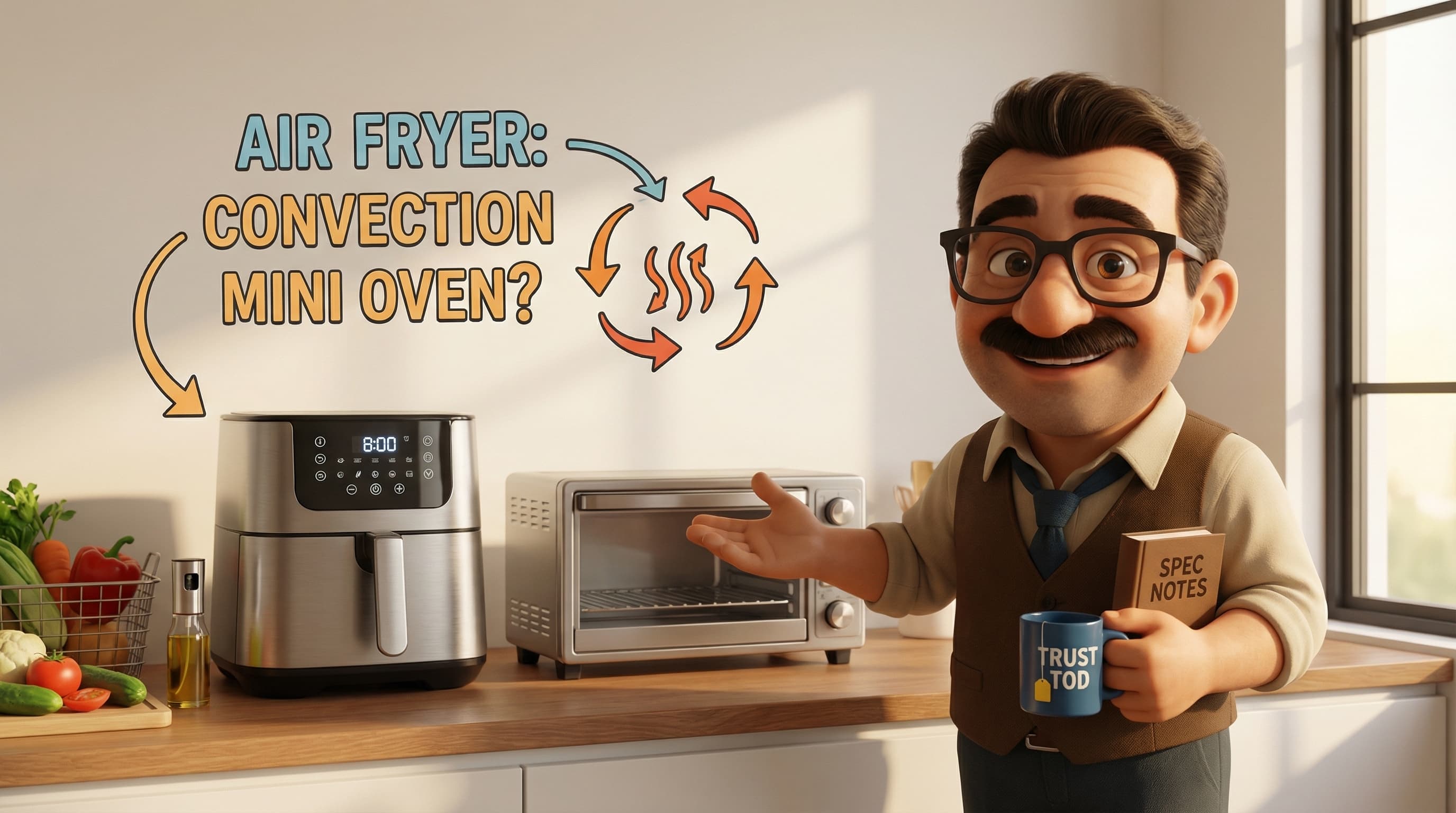
The Great Kitchen Debate: Are We All Just Buying Tiny Ovens?
Picture the scene: It’s a Sunday afternoon, the rain is lashing against the window pane (standard British summer, then), and you’re at a dinner party. You casually mention you’ve just bought an air fryer and you’re absolutely chuffed with the results.
Suddenly, the room goes quiet. Someone’s uncle, let’s call him ‘Sceptical Steve’, puts down his fork, adjusts his glasses, and delivers the line we’ve all heard a thousand times:
"You do realise, don't you? It's just a glorified mini oven. You've spent a hundred quid on a fan heater in a plastic box."
It’s enough to make you choke on your roast potato. But here’s the thing—Steve isn’t entirely wrong. But he’s also spectacularly missing the point.
As someone who spends his days analysing the nuts and bolts of kitchen tech for tod.ai, I hear this debate constantly. It is the single biggest myth stopping people from upgrading their kitchen game. So, grab a cuppa, and let’s settle this once and for all. Is the air fryer the culinary revolution of the decade, or is it just hot air?
The Myth: Why Steve Thinks He’s Right
Let’s give credit where it’s due. The sceptics have a solid foundation for their argument. If you strip an air fryer down to its bare bones, the mechanics are remarkably familiar.
Inside that sleek countertop gadget, you will find two main components: an electric heating element (usually a coil, much like a grill) and a fan. If you look inside your built-in kitchen oven, you will find... an electric heating element and a fan.
Technically, an air fryer is a convection oven. That is a scientific fact. It circulates hot air to cook food. So, when people say it’s a "glorified mini oven," they are identifying the correct genus, if not the correct species. It’s a bit like saying a greyhound and a pug are both "just dogs." Yes, they are. But if you want to win a race, you’d be mad to bet on the pug.
This belief persists because, on the surface, the result looks similar: hot food. But as any chef will tell you, how you get the heat into the food changes everything about the texture and flavour.
A Brief History of Hot Air
To understand why we’re even having this argument, we need to hop in a time machine—not to 2010 when Philips launched the first 'Airfryer', but back to the 1940s.
The technology isn't actually new. The "Maxson Whirlwind Oven," invented in 1945, was the granddaddy of convection cooking. It used a fan to circulate air, aiming to heat up frozen airline meals quickly. It was essentially an air fryer the size of a fridge.
Fast forward to the late 90s and early 2000s in the UK. Do you remember the "Halogen Oven" craze? Those massive glass bowls that sat on your counter, glowing with the light of a thousand suns? They were touted on teleshopping channels at 3 AM as a miracle cure for cooking. These were the missing link—the bridge between the standard oven and the modern air fryer.
The problem was, early marketing for air fryers was a bit... ambitious. Advertisers screamed, "Fried food without the fat!" Consumers bought them expecting the exact taste of chip-shop chips—that distinctive, greasy, oil-saturated texture. What they got instead was a very crispy roasted potato. It was delicious, but it wasn't deep-fried. This disappointment fuelled the cynical backlash: "It’s just a small oven!"
And to be fair, in the early days, low-end models were just that. If you had a dodgy £30 model in 2012, it probably was just a hair-dryer aimed at a potato. But technology moves fast, my friends.
The Truth: It’s All About the Velocity
Here is where we leave the myths behind and look at the physics. While the components (fan + element) are the same as an oven, the application is completely different.
Comparing a modern air fryer to a standard fan oven is exactly like comparing a pressure washer to a garden hose. Both pump water. Both can get your car wet. But only one is going to blast the mud off the wheel arches in three seconds flat.
1. The Coanda Effect and Air Velocity
Here’s the science bit (don’t worry, I’ll keep it brief). In a standard UK oven, the fan gently moves air around to ensure the temperature is roughly the same on the top shelf as the bottom. It’s a gentle breeze.
In a modern air fryer, the fan is an aggressive beast. It drives air around the chamber at incredibly high speeds. Manufacturers like Ninja and Philips have spent millions designing 'cyclonic' or 'starfish' airflow patterns. This high-velocity air creates something called the Coanda effect, where the air clings to the surface of the food, stripping away the boundary layer of cool moisture that usually surrounds your chicken nugget.
2. The Maillard Reaction
To get food crispy—that golden brown crunch we all crave—you need the Maillard reaction to happen fast. This chemical reaction requires high heat and a dry surface. Because an air fryer is small and the air is moving so violently, it dries the surface of the food almost instantly, allowing it to brown and crisp up in a way a standard oven simply cannot replicate without drying the inside of the food out too.
3. Radiant Heat Proximity
In your big oven, the heating element is hidden away at the back or the top, miles away from your sausages. In an air fryer, the food is often sitting just inches away from the element. You are getting the intense radiant heat of a grill (broiler) combined with the circulation of a convection oven. That is a powerful combo.
Modern Reality: Not Just For Chips
If you’re still clinging to the idea that it’s just a gadget for frozen chips, you’re living in the past. The UK market has shifted dramatically in the last few years.
The Energy Argument
We’ve all been watching our smart meters like hawks recently, haven’t we? According to the experts at Which?, cooking a chicken breast in an air fryer costs roughly half as much in electricity as firing up a built-in oven. Why? Because you aren't heating a huge metal box just to cook one piece of poultry. An air fryer hits 200°C in under three minutes; my main oven takes nearly fifteen just to clear its throat.
The Dual-Drawer Revolution
The game-changer for British families was the arrival of the dual-drawer models. Suddenly, this wasn't just a side-dish maker. You could do your salmon in one drawer and your asparagus in the other, and hit a button so they both finish at exactly the same time. Try coordinating that with a standard oven and a stopwatch while the kids are screaming for tea.
However, let's address a few misconceptions that even air fryer fans get wrong:
- Misconception: "It tastes exactly like deep-fried food."
- Reality: It doesn't. It tastes like super-roasted food. The crunch is drier and louder. It's better for you, but don't expect the grease.
- Misconception: "You don't need any oil."
- Reality: If you use zero oil on homemade wedges, you will get hot, dry leather. You need a light spray to conduct that heat. Don't be afraid of a teaspoon of oil!
- Misconception: "It's always cheaper."
- Reality: If you are cooking a full Sunday roast for six people, use the big oven. Running an air fryer for four consecutive batches to feed a crowd is a false economy.
The Verdict: Myth Busted (Mostly)
So, is Sceptical Steve right?
Technically: Yes. It is a mini convection oven. Functionally: Absolutely not.
The result you get from an air fryer—the speed, the crispiness, and the energy efficiency—is distinct enough to warrant its own category in the kitchen. It does things a standard oven cannot do, in a timeframe a standard oven cannot match.
Think of it this way: A microwave is technically just a radio wave emitter, but you wouldn't say it's "just a glorified radio," would you? It’s about how the technology is applied.
If you are cooking for a huge family feast, keep the big oven. But for the daily grind—the Tuesday night fish fingers, the quick roasted veggies, the reheating of yesterday’s pizza (which, by the way, comes out better than fresh)—the air fryer is king.
It’s not magic, it’s just very clever physics. And frankly, if it gets dinner on the table in 15 minutes with less washing up, I don't care what we call it. I’m sold.
Still confused about which model will fit your kitchen counter (and your budget)?
Don’t guess. Let me help you sort the wheat from the chaff. Head over to tod.ai and I’ll find the perfect match for your cooking style in seconds. Cheerio!
Related reading: